SOURCE – In today’s oversaturated digital music landscape, what are the biggest challenges you’ve faced in trying to make your album stand out from the thousands of weekly releases?
Lionel Cano Muñoz (Rhythm, Lead & Spanish Guitars) – Today, one of the biggest challenges for a band is capturing attention amidst the constant and frenetic flow of releases. Audiences are bombarded from all sides, and even a sincere, powerful album with a true identity can get lost.
We have a unique concept and music that can make us stand out from the crowd, but it’s still difficult because the communication must reach the audience before it can be read, seen, or heard. In the internet age, it’s never been easier to discover music from around the world, but at the same time, it’s never been more difficult to be heard.
We’re also fortunate to be signed to Season of Mist, a high-quality and renowned record label that certainly helps us resonate more. But even that isn’t enough.
We had to be extra creative, both musically and visually. We focused on authenticity—on offering a unique project that blends extreme metal with Spanish musical heritage. It’s a bold gamble, but it’s this uniqueness that truly allows us to exist.
SOURCE – The infusion of Spanish musical influences is evident in your latest album. How did you navigate blending traditional Spanish elements with your band’s unique style, and what challenges did you face in maintaining authenticity while exploring such a culturally rich genre?
Lionel Cano Muñoz (Rhythm, Lead & Spanish Guitars) – It’s a delicate balance. We definitely didn’t want to create Spanish “folklore” superficially pasted over metal. Spain—more specifically Andalusia—has an exceptional musical and emotional richness. We’ve always been immersed in it, thanks to our Spanish roots and family heritage.
The challenge was respecting certain aspects of these cultural traditions while managing to blend them seamlessly with the power and brutality of metal.
To do this, you have to understand the codes, know how to adapt them without breaking them, and, above all, play with passion and sincerity. Impureza’s music is ultimately emotional—even poetic in some ways. But above all, we strive not to fall into caricature.
SOURCE – In terms of production, how did you approach the sound of this album differently from your previous works? Was there a deliberate choice to experiment with specific Spanish instruments or rhythms? What role did technology and modern production techniques play in bridging the gap between traditional sounds and contemporary music?
Lionel Cano Muñoz (Rhythm, Lead & Spanish Guitars) – With Alcázares, we wanted to take things to the next level. We explored the sonic textures of traditional instruments more deeply: flamenco guitar, of course, acoustic bass, and also Latin and Oriental percussion—all real instruments, not digital samples!
Our main goal was to create a sincere album that would stand the test of time. Producing an album is expensive, time-consuming, and, above all, requires a lot of sacrifice—so it was crucial for us to take great care in its recording and composition.
To achieve this, we chose to work with Sébastien Camhi, who owns a magnificent studio in the south of France and offered us a recording and mixing approach that blends both digital and analog techniques.
We are very happy with the result—it sounds natural yet produced, massive yet airy, and very detailed. Jacob Hansen also did a wonderful job on the mastering! Working with him on Alcázares was a real source of pride, especially considering his resume: Volbeat, Arch Enemy, The Black Dahlia Murder, and more.
Moreover, our musical concept—a fusion between flamenco and metal—is arguably more complex than a traditional death metal album. The blending of genres truly challenged our friend Sébastien, but he did an outstanding job. The album is both clear and powerful!
SOURCE – How important was it for you to ensure that the Spanish elements in your album were not only musical but also lyrical? Were there any specific Spanish phrases, words, or cultural references that you felt were crucial to conveying the story you wanted to tell? How did those choices shape the writing process?
Lionel Cano Muñoz (Rhythm, Lead & Spanish Guitars) – In Impureza, the Spanish language is a weapon in its own right. It’s a language rich with emotion, fervor, and tragedy. We couldn’t limit our evocation of Spain to just musical aspects.
Our lyrics are tinged with historical references, but we always aim to make them more fantastical and mystical than purely factual. Our goal isn’t to recount history, but to tell compelling stories.
That said, you’ll find many recognizable cultural references: Tizona del Cid, Boabdil—the last emir of Al-Andalus—Torquemada, the infamous inquisitor, and the Battle of Covadonga. But there are also plenty of myths and legends interwoven throughout.
The key is to make everything coherent—to present the album as a unified story where listeners can find meaning, make connections to specific events, and still experience a dreamlike narrative.
SOURCE – How would you describe the evolution of your music since your previous album, La Caída de Tonatiuh (2017)?
Lionel Cano Muñoz (Rhythm, Lead & Spanish Guitars) – With La Caída de Tonatiuh, we pursued a more progressive, more complex direction. The universe of the Aztec people and their legends led us into a culturally rich and fascinating world.
It’s a dense album—one that demands several listens to appreciate all its nuances. It was certainly an ambitious effort.
Alcázares represents a maturation. We’ve gained precision in writing, composition, and production. The approach is more cinematic, more narrative. We’re no longer focused solely on impressing, but rather on taking the listener on a journey to the heart of old Spain’s history. It’s a more embodied, more spiritual work—likely because it’s closer to our roots.
Most importantly, it’s a different album that complements the previous one beautifully. We began a trilogy: La Iglesia del Odio for the Inquisition, La Caída de Tonatiuh for the Conquest, and now Alcázares for the Reconquest.
SOURCE – What are your thoughts on the current state of music video culture? Are visuals more important now than ever, or are they losing their impact?
Lionel Cano Muñoz (Rhythm, Lead & Spanish Guitars) – In this era of instant gratification, visuals have become the primary point of contact. They’ve never been more important than they are today.
The problem is that with so many bands and so much content, music videos often feel redundant—a copy of a copy, indistinguishable from the next.
That’s why we took our time developing ours. We wanted to be sure of the message we were conveying, because a video is an extension of the music.
Our message is clear: it’s a chance to ground our musical universe in a visual form—to truly bring our stories to life.
We put as much care into our videos as we do into writing our songs. A music video like Pestilencia takes six months of development, research, scouting, paperwork, three days of filming, and hundreds of hours of editing and color grading. It was a huge challenge, but seeing the response made it all worthwhile!
SOURCE – You recently filmed a video for the track “Pestilencia.” Could you tell us a little bit about it? Who came up with the concept?
Lionel Cano Muñoz (Rhythm, Lead & Spanish Guitars) – The main idea for the Pestilencia video—the depiction of plague scenes—came from a discussion with our singer Esteban Martin, who brought it up.
We then developed the concept together, discussing how each musician would appear in each scene. That’s how it all began.
As we moved forward with director Michel Canavaggia from Cana Prod and his team, we built the complete visual narrative.
The personification of the plague takes the form of a peddler who spreads disease within a cursed castle. This character carries paintings representing his past victims, displayed like trophies in this abandoned place.
Throughout the video, the band members gradually fall ill before confronting the peddler. In the final scene, their fate is revealed. There’s also a symbolic brushstroke at the end, aimed at the camera, which can be interpreted in two different ways—it’s up to you to discover them!
All this serves the visual side, but the clip’s depth lies elsewhere. In medieval times, the plague was seen as divine punishment. We used that ancient religious superstition to make the story feel more mystical and poetic—with this enigmatic, plague-bearing painter at its core.
SOURCE – Although Impureza is a Franco-Spanish metal band, I’d like to talk about the Spanish metal scene. What impact did Barón Rojo and Ángeles del Infierno have on the culture and identity of Spanish metal music?
Lionel Cano Muñoz (Rhythm, Lead & Spanish Guitars) – They are pillars. Without Barón Rojo or Ángeles del Infierno, metal in Spain wouldn’t have the same identity. They were the first to establish a strong Spanish-language presence in a predominantly Anglophone genre. They paved the way for countless bands who realized they could embrace their roots, sing in their own language, and express their culture. We are the heirs of that vision—creating rooted metal that never denies its origins.
SOURCE – What’s next for the band after the album is released?
Lionel Cano Muñoz (Rhythm, Lead & Spanish Guitars) – We want to promote this album live, with as many concerts as possible—in France, across Europe, and hopefully beyond!
Our first show will be near Paris at the Mennecy Metal Fest, where we’ll present a special performance featuring flamenco dance integrated into our Hispanic metal concert.
We’re fortunate to be joined by the incredible flamenco dancer Cécilia Cappozzo for this concert—and hopefully for many more!
Our goal is to offer more than just a metal show. We want to create an experience—an Impureza show. And deep down, we’re already thinking about the next chapter… because as long as the soul vibrates, Impureza continues to write its story.
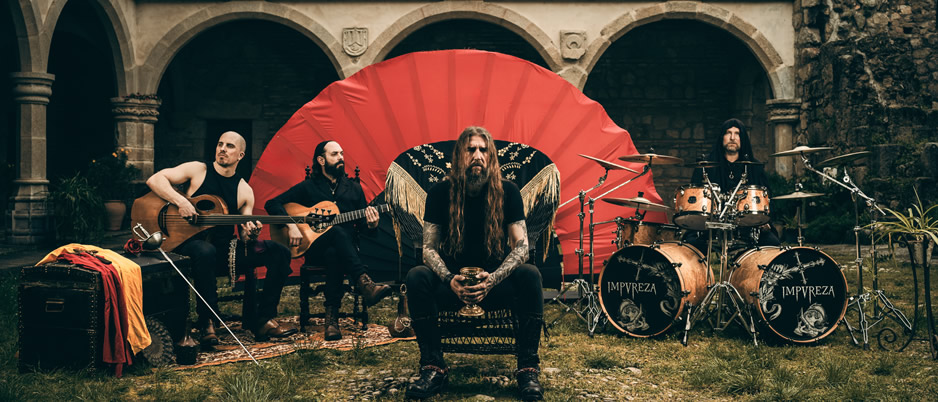
Photo Credit: Michel Canavaggia/Mr Cana Photography
Contacts:
Video:
- NOTE ABOUT AI USE IN THIS DOCUMENT!
This document has been thoroughly reviewed and corrected for spelling, grammar, and syntax errors using advanced AI-driven proofreading tools. The AI system used is designed to analyze and enhance the language of the text, ensuring it adheres to proper English conventions while maintaining the original meaning and tone.
The proofreading process involved identifying and correcting typographical errors, sentence structure issues, and inconsistencies in punctuation. The document has been refined to meet the highest standards of spelling, grammar, and overall readability.