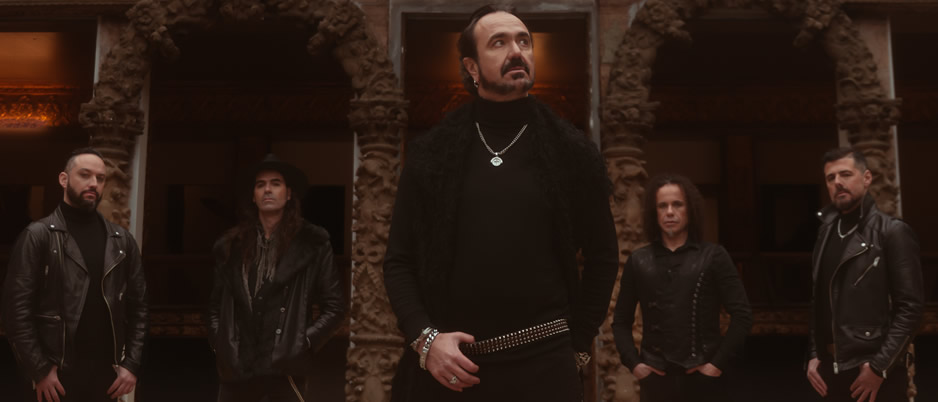
SOURCE – Congratulations on the release of Far From God. Would you say this is a stronger album lyrically or musically?
Fernando Ribeiro (Vocals) – I don’t think you can make that distinction with Moonspell because both dimensions coexist.
We compose in a rather theatrical way. The lyrics often function as a script for the songs, guiding their atmosphere, narrative, and emotional progression. The opposite is also true: I listen to the first musical sketches, and they immediately suggest words, images, and stories.
What satisfies me most about Far From God is its coherence and simplicity. Every note, every melody, every arrangement, and every verse points towards the same destination. I honestly believe it is our most refined album to date, our most sophisticated, balanced, and focused work.
SOURCE – One of the album’s songs is called “Reconquista”, a Portuguese word, although only one verse is sung in Portuguese. Why?
Fernando Ribeiro (Vocals) – There is a strong Nietzschean current running throughout the album, from its title to its closing track. Nietzsche often speaks about the loss of the original impulse behind words and ideas, and how that gradually shapes our mentality and the way we live. He also suggests that there is a path back to our original human potential. We called that path Reconquista.
It is not a historical concept. It has nothing to do with the territorial reconquest of Portugal in the Middle Ages. In many ways, it follows the tradition of songs such as “Fullmoon Madness”, “Alma Mater”, “Tired”, and “The Future Is Dark”: almost autobiographical reflections on what it means to belong to a band, encompassing sacrifice, joy, defeat, and, ultimately, recovery.
Some words lose their soul when translated. Reconquista is one of them. It is history, memory, geography, and metaphor all at once. English can explain the word, but it cannot inhabit it.
The verse in Portuguese functions almost like an invocation. It reminds the listener, and perhaps ourselves, that Moonspell remains deeply rooted in a very particular corner of Europe, with its Catholic ghosts, melancholy, and contradictions.
Sometimes a single sentence in your mother tongue says more than an entire song in English.
SOURCE – Which Brazilian writers have had the greatest influence on your writing?
Fernando Ribeiro (Vocals) – Brazil has an extraordinary literary tradition, whether in poetry, fiction, or non-fiction. Brazilian authors have helped me unravel the mystery that is Brazil itself.
My curiosity about the country has no limits. Lately, I have been reading authors such as Darcy Ribeiro and Boris Fausto to better understand contemporary Brazil, which, strangely enough, remains largely unknown in Portugal.
As far as my own writing is concerned, I probably feel closest to Álvares de Azevedo and Cruz e Sousa. Cecília Meireles has always enchanted me as well. There is something in Brazilian literature that combines melancholy, sensuality, and humanity in a uniquely compelling way.
SOURCE – How important are intimate events such as the Far From God presentation at Quinta da Ribafria in today’s increasingly competitive music industry?
Fernando Ribeiro (Vocals) – They are becoming more important than ever because they restore something we are rapidly losing: genuine proximity.
Everything today is designed to make us consume faster, react faster, and forget faster. We wanted to do exactly the opposite. We wanted people to sit down, listen to the album from beginning to end, ask questions, share a glass of wine, and simply be present.
Before algorithms, influencers, and marketing strategies, there were artists and audiences. I hope we never lose that direct human connection.
SOURCE – What is your opinion on Meet & Greet sessions?
Fernando Ribeiro (Vocals) – A necessary evil. Personally, I would rather meet people in a second-hand bookshop or at a local bar than in a carefully timed Meet & Greet session. Sometimes we do paid Meet & Greets because contracts require them or because fans genuinely ask for them.
If I could choose, however, I would much rather sit down, share a drink, and talk without a stopwatch running or money changing hands.
Unfortunately, life on the road does not always allow for that.
SOURCE – How do you assess the evolution of the live music infrastructure in Brazil?
Fernando Ribeiro (Vocals) – Brazil has evolved tremendously from a technical standpoint. Productions are more professional, there are excellent promoters, and many venues now operate at an international standard.
The audience, however, never needed to evolve. Brazilian crowds have always been extraordinary.
The biggest challenge remains geography. Touring Brazil is almost like touring Europe in terms of distance, but with considerably higher logistical costs.
Even so, it is always worth it. Brazilian audiences do not simply attend concerts; they live them.
SOURCE – Can Brazilian fans expect Moonspell to return in 2027?
Fernando Ribeiro (Vocals) – That is certainly our hope. Brazil is one of those countries where Moonspell has never felt like a foreign band. There is a very special emotional connection that has survived changes in the music industry, shifting trends, and the passage of time.
We would love not only to return to the cities that have always welcomed us so warmly, but also to finally reach places where we have never had the opportunity to perform.
Far From God deserves that journey. And Brazilian fans do too.
Photo Credit: Sonja Schuringa
Contacts:
Video:
- NOTE ABOUT AI USE IN THIS DOCUMENT!
This document has been thoroughly reviewed and corrected for spelling, grammar, and syntax errors using advanced AI-driven proofreading tools. The AI system used is designed to analyze and enhance the language of the text, ensuring it adheres to proper English conventions while maintaining the original meaning and tone.
The proofreading process involved identifying and correcting typographical errors, sentence structure issues, and inconsistencies in punctuation. The document has been refined to meet the highest standards of spelling, grammar, and overall readability.