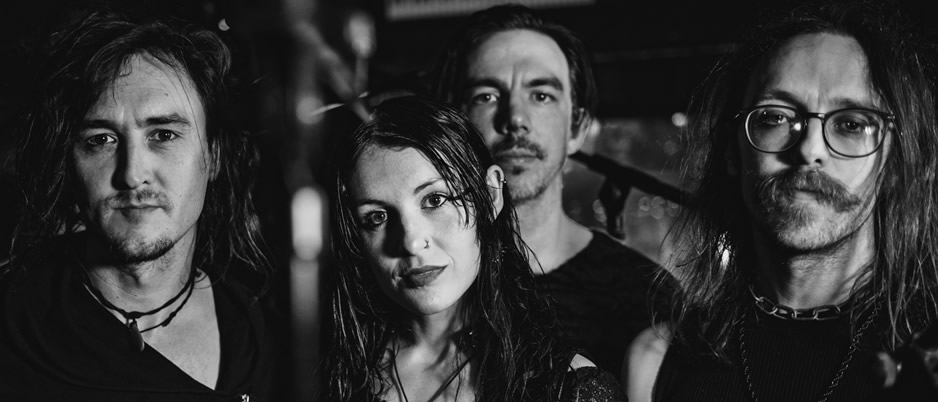
SOURCE – Congratulations on your fantastic album, “The Wounded Healer.” Could you please tell us a little about it? What is your strongest memory from the recording process?
Amy Montgomery (Vocals) – Thank you! “The Wounded Healer” is our debut record that aims to find meaning and purpose in oneself and the collective of humanity by recognizing that our wounds can indeed be our biggest teacher and source of our potential. It is filled with lessons, questions, anger, joy, dualities, and contradictions!
Most of this album was written and demoed on Wolfe Island in Canada where we spent one month in the dead of winter. The huge window looking out to a completely frozen Lake Ontario served as the perfect backdrop for contemplation. Our friends at Hotel Wolfe Island turned the entire downstairs of their hotel into a makeshift studio for the entire off-season. This meant that we had a space to stay, write, and track. When we were happy with a very rough demo upstairs, we’d bring it downstairs and track it properly. We kept some parts of the Wolfe Island demos for the final versions; the rest was recorded at our Tree Song Studios in Ireland, produced by PREYRS’ Micheal Mormecha.
The whole process was an incredibly unique experience. The magic of writing “The Wounded Healer” was truly in changing everything around us to create a collection of songs we might never have written otherwise.
SOURCE – The press release mentions the band’s beginnings: “Busking on the streets of Belfast from the age of 15, Amy Montgomery met multi-instrumentalist Micheal Mormecha a few years later and they’ve been working together ever since.” Do you still carry any influence from that initial time in Belfast?
Amy Montgomery (Vocals) – Of course! I will always remember what and who influenced the person and artist I have become and am becoming. That was a complex but profound time for me. I was using music and expression by busking as a means of processing the loss of my mom to suicide when I was 16. That time busking in Belfast thankfully gave me a much-needed release and sense of purpose. It also taught me the importance of listening to people’s life stories and experiences, especially people living on the streets. Because of this, I didn’t feel so alone with my troubles. I will carry this influence with me for the rest of my life and be forever grateful that it led me to work with the amazing people I know and, of course, the evolution with Micheal Mormecha that you now hear as PREYRS!
SOURCE – The sound of “The Wounded Healer” is distinctive, with unique timbres. Could you describe the production process and the equipment used to achieve this sound?
Micheal Mormecha (Drums) – Thank you! It was perhaps a byproduct of not using our own equipment on Wolfe Island. We borrowed everything, including a ’60s Gretsch for writing from Rocky, Neil Young and Patti Smith’s former guitar tech. Every instrument makes you play or approach a part slightly differently. Though we wouldn’t have necessarily gravitated toward this vintage gear, it was all that was available, and it definitely brought a quality to the tracks that developed over our time there. Fusing this vintage feel with the synths to create that synergy of organic and electronic, of course, added to the sound. Even though we record digitally, we try to embrace an analog ethos of limiting tracks and being selective of what goes into our recordings.
SOURCE – The album cover is often the first thing fans see. What message or emotion did you aim to convey through the artwork?
Amy Montgomery (Vocals) – Our album cover is the simplicity and power of the PREYRS logo. We want this to become something people recognize and connect with the music. The lyrics are vitally important to us, so we had to include some inside the CD and vinyl. It’s a little bit of a guessing game as to which song each one is from!
SOURCE – You recently filmed some videos for the tracks “Zeros, Ones & Lies (Live at Riddel’s Warehouse, Belfast)” and “Wave Of Wisdom (Live at Riddel’s Warehouse, Belfast).” Could you tell us a little bit about them?
Amy Montgomery (Vocals) – Sure! These were the first-ever PREYRS live sessions. We wanted to capture the feel of PREYRS in more than just a sonic way. When I found Riddel’s Warehouse after searching for the right location, I instantly knew it was perfect. Riddel’s, an 1867 ironmongery in Belfast, operated until 1973 when a series of firebomb attacks and the difficulty of operating within the security barricades around the center of the city (during The Troubles) forced its owners to move elsewhere.
Micheal packed up his studio, unloaded it into Riddel’s, and we tracked five songs live in one day. The videos were beautifully shot by Je Suis Le Cat and the audio recorded and mixed by Micheal. We are so happy with how they turned out. Performing these songs in a place steeped in history was an incredible honor!
SOURCE – How has the rise of streaming platforms like Spotify changed your perception of what it means to release an album, particularly regarding pacing, song arrangement, and listener retention?
Micheal Mormecha (Drums) – I consume most of my favorite music still via album format. That 30-to-50-minute journey still resonates with me as a listener and as a creative. We are the kind of band that gets in a van and plays everywhere. We connect with people one by one, self-produce our music, and even screen-print our own CDs and vinyl. This hands-on approach has sustained our journey in music for years. So, while DSPs are far from ideal for the artist, they can be useful for discovery. I actually like that algorithms have pushed people back to really consider arrangements. Look at the early Beatles songs: they had three choruses and a middle eight, sometimes under two and a half minutes. The ’90s got self-indulgent and lazy. If it’s pop, then just let it pop; if it’s a symphony or “Bohemian Rhapsody,” that’s cool too—it really depends. Equally, I love to see bands like Sleep Token prove that their fans are willing to invest in the six-to-eight-minute song format. That’s a fresh playground for this generation.
SOURCE – Has your approach to album promotion changed with the shift toward streaming and digital media? Do you feel that traditional methods—such as radio play and print media—still have weight, or have they largely been replaced by newer strategies?
Micheal Mormecha (Drums) – I think radio, in particular, is still vital for new bands to break. I’m not sure about print anymore—who is really spending £5 on a magazine in 2025? All I know is that we spend a lot of time building reels and content to support a release, but it is crazy, time-consuming work, and it’s time away from developing new material, so it’s tough. On the flip side, we can do it, and we don’t need a massive budget!
SOURCE – Is there anything you’d like to say to those who’ve supported you from the beginning—and to those who are just now discovering your music?
Amy Montgomery (Vocals) – It’s impossible to truly express every layer of the words “thank you.” Those who have supported from the beginning have held space for us to express ourselves and be seen throughout this process. This means more than I will ever be able to describe.
To those just discovering our music, I am happy that it is already resonating. There are many more layers of PREYRS to discover, and you will not regret sticking around for what we believe will be a beautiful future.
We hope you find a connection with each other too and be encouraged to feel, to trust, and to build yourself into the person you truly want to become.
Photo credit: David Cleland
Contacts:
Video:
- NOTE ABOUT AI USE IN THIS DOCUMENT
This document has been thoroughly reviewed and corrected for spelling, grammar, and syntax errors using advanced, AI-powered proofreading tools. The system is designed to analyze and enhance the text while preserving its original tone and meaning in accordance with standard English conventions.
The proofreading process included the identification and correction of typographical errors, sentence structure issues, and punctuation inconsistencies. The document has been refined to meet the highest standards of grammar, spelling, and readability.